Mobile marketing tips for small businesses
Mobile marketing tips for small businesses

Jun 17th
 With the mobile trend in full swing, and gaining momentum every day, many small businesses have wisely published apps to stay ahead of the competition.
Accordingly, the strategy of offering a bribe to obtain a download has become common. Users are given discounts, freebies, promotional offers, and other enticements by small businesses in order to gain downloads. The hope is that this will allow the business to create a user base that will generate returns as time goes on.
In this post, however, we want to offer an alternative strategy. With the well-known struggles of the daily dealmakers and other hot discounting outfits, offering something for nothing is not by any means a guaranteed win. Small businesses sometimes simply wind up cannibalizing their own profits by offering things that loyal customers might have bought anyway. Instead, we think that small businesses should try something different when it comes to their next app:
Deliver something unique (and cost-effective).
Of course, this is easier said than done, but don’t click that back button just yet. We have some examples of how common businesses can offer something desirable to customers and fans without necessarily cutting into profits:
• Law offices. Offer an invite to a webcast where you chat about practical tips for a situation that occurs often in your practice area.
• Real estate agencies. Offer would-be sellers a free assessment of the sales prospects of their home, including tips for preparing it for sale.
• Restaurants. Allow loyal customers skip-the-line rewards for downloading and using your app.
• Bars. Provide a schedule of live acts scheduled to perform at your location through your app, or perhaps offer users the ability to vote on their favorite next act to be booked.
• Bands. Offer an unreleased track or some other content that fans will be into (even if it isn’t polished).
• Nonprofits. Allow users to submit a thought/reflection about your issue, with the promise that your favorites will appear on your site, or get a social media shout out.
Ultimately, the best strategy is different for each business. If you’re willing to consider what loyal users might be interested in, aside from discounts, and be flexible, you may be able to maximize the returns from your app efforts.
This may even require you to simply ask users what they’d like to get from your app. (In fact, you should ask them anyway!) The more you know about your fans, the better designed your app will be, and the more users it will gain.
Be creative, and your app will reward you as much as it does your customers.
Jun 14th
 For any challenge faced by a small business owner, we try to find an “app answer.” Accordingly, each of the apps below is a solution to a common problem encountered by small business owners. Have a look – your biggest problem might be solved by a blog post, today!
Problem: Accounting and billing aren’t seamless or remote-accessible
Solution: Freshbooks Cloud Accounting
If you’re still living in the darkness of “Spreadsheet Land,” it might be time to step out into the light of day. It’s 2013, and cloud-enabled tools like Freshbooks provide enough advantages to put old-school solutions to shame. With anywhere access (even from mobile devices), your business’s accounting can become more seamless and easier to manage than ever before. Using Freshbooks, you can log time, bill clients, track expenses, and generate reports about your finances at any time, automatically. Welcome to the future!
Problem: Keeping tasks organized and coordinating the team is a nightmare
Solution: Orchestra To-Do
Getting things done and keeping them organized is officially easy, with Orchestra. You can speak your tasks into the phone, have them sync across your devices and platforms, integrate with email, share tasks, chat with team members, set reminders, and more. Email and calendar apps are useful, but Orchestra takes things to a whole new level, bringing your team together to get things done like never before.
Problem: People that aren’t in my office can’t see what I’m trying to show them
Solution: Join.me
Join.me offers instant meetings and screen sharing. You could keep describing things endlessly over the phone, or you could just use Join.me, and it will be like the person you’re talking to is in the room with you. Physical barriers should really be no excuse for collaboration problems, at this point. And Join.me is yet another tool you can use to break down the walls that make working remotely difficult.
Problem: I’m all over the place, and so are my trip documents
Solution: Tripit
If your business requires team members to travel frequently, Tripit is the solution you’ve been waiting for. Instead of having to cut and paste trip details into calendars, Tripit keeps everything in one place, neatly organized, and easily sharable or editable. You can also set up alerts, access everything from your mobile device, and manage team trips easily. Stop digging through emails. Let Tripit be your travel secretary!
Problem: I want to promote my business easily online
Solution: Localvox
You know that mobile online marketing is a big opportunity for small businesses, but you don’t know how to make the most of it. Well, now you don’t have to learn. Localvox will handle everything for you, sending promotions wherever they need to go, including your email list, social media channels, and websites. With the wealth of apps now available, coordination of pretty much everything is now someone else’s job. Enjoy your “retirement!”
Jun 11th
 Absolutely Not.
(But avoiding them certainly seems to be!)
Okay, we’re a bit biased since one of our businesses is creating great apps for small businesses, but our opinion is based on solid facts. Businesses that use apps to boost internal operations and interact with customers are reporting major benefits that have a direct impact on their bottom line.
According to a report by the Small Business and Entrepreneur Council, 78% of small business owners polled said they save time by using apps. On average, these owners estimate they save more than 5 hours each week. Monetized, this leads to an estimated yearly savings of over $14,000 each year! (And for the larger small businesses, this figure could be much higher.)
The takeaway is simple: apps save you money. But that’s just in-house. What about customer relationships?
Well, users are spending 127 minutes in apps on average each day. It’s safe to say that people love apps. Businesses that capitalize on this fact can enjoy a number of benefits. Mobile apps let businesses reach customers anytime, anywhere, and offer a world of useful, creative functions that cement and improve the relationship between parties. This leads to happier customers, increased sales, and excellent referrals.
How are they doing it? There are many ways to use apps to connect with customers:
• Push notifications with promotional offers or invitations to events
• Reservation or appointment scheduling
• Mobile shopping
• Support requests
• Feedback
• and more!
So, why are some businesses ignoring these benefits? For most, it’s simply a lack of understanding, and the fear that the effort will be costly and irritating to maintain. But with simple solutions now available, these fears are largely unrealized. And with many billions of apps now being downloaded each year, it’s clear that apps will be with us, and will remain quite important, for some time to come.
Sorry, no fads here!
If you want to make sure your business is the one taking advantage of mobile technology, instead of being taken advantage of, we can help.

Apr 24th
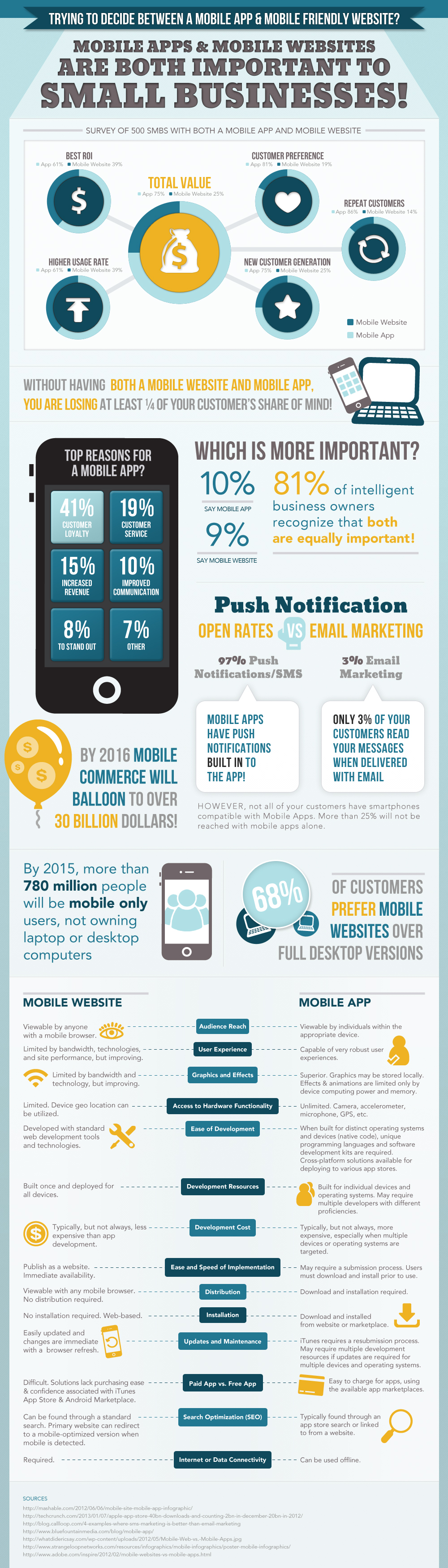
By 2015, it is estimated that close to a billion consumers will be using mobile devices only (no laptop, no desktop). And many, many others will be using their mobile devices more often than their other devices. For small businesses, this means that maintaining a mobile presence is highly important, if not essential.
The main choice many business owners face is, “Should I have a mobile website or an app?” Luckily, the answer is clear: both!
Recently, we surveyed 500 small businesses that have mobile websites and apps, and 81% said both are equally important!
Here are the highlights:
Mobile website versus mobile app:
• Value. 61% said an app provided a better return on investment.
• Customer preference. 81% said customers preferred the app to the mobile website.
• New customer generation. 75% said app was better for customer generation.
• Repeat business. 86% said app was better for creating repeat customers.
• Usage. 61% said app was used more often.
The app pretty clearly has the edge in the opinion of most small business owners. But that doesn’t mean that apps are right for everyone. The infographic found below contains the rest of our findings, and a wealth of information for small businesses considering “going mobile.”
Click here to download the high resolution white label version.
(Right click link above and save link as.)
Apr 22nd
 The quality of your App Store description can have a huge impact on downloads, so it pays to think it through, design it carefully, and make sure you get it right. While there are variations in the ways that each type of app should be presented, depending on function and target market, the tips below cover the most important things to keep in mind if you want your description to help, rather than hurt, the success of your app.
(As always, step zero is “Build a great app.”)
1. Get to the point
In the first few sentences, let people know what the app does and what the benefits are. Don’t get too lost in details and jargon; just get your point across quickly. Users are often browsing for a solution to a problem, and if you don’t say you solve that problem up front, you can lose a lot of potential downloads.
2. Keep it simple
This ties in to the first point. Your app may have a lot of neat features and use cases, but it generally pays to focus on your core offering in your description. Once core users are liking your app and submitting favorable reviews, you can worry about branching out into secondary markets.
3. Search engine optimization (SEO)
Rule number one of the Internet: be findable.
A distinctive and unique app title is nice, but sometimes the direct approach is better. Your GPS-enabled bathroom locator might sound cute as “PottyMap,” but “Bathroom Locator” or “Bathroom Finder” will bring you far more organic search leads. Follow through on this approach in your description as well. Hit popular and relevant keywords, and ensure that your description is working for multiple purposes and bringing searchers to your page.
Don’t be spammy, though. Just make your words serve SEO where possible, and only where your text will still sound natural.
4. Use a couple of screenshots
Don’t go overboard, but if your app is nicely designed, give prospects a taste of the user experience with a few screenshots. Sometimes, images are exactly the shortcut you need to connect with certain prospects who prefer to learn visually.
As always, a picture is worth a thousand words.
5. Consider including quotations from reviews or testimonials
Testimonials on sales pages have been found to boost sales. If you can find a way to work a credible testimonial, or better yet, an independent and favorable review quotation into your description, do it. The “outside voice” is more convincing to the consumer than the “inside voice,” who is always going to say that everything about the app is great. With testimonials and reviews, you gain the most important thing in sales: credibility.
6. Include a call to action
A clear CTA is a must-have at the end of your description. It should be straightforward, and something as simple as “Try it free, today!” is just fine. If you can generate a little urgency and excitement, even better.
As a final note – play around with a few descriptions if you’re not sure what will work best. Test different pages, tweak them based on what you learn, and then use the one that produces the highest conversions.
See you at the top of the charts!
Apr 18th
Recently, the digital analytics company comScore released a report regarding mobile trends that contains a number of useful facts for those trying to target buyers on their mobile devices. As new technologies are introduced and user behavior continues to adapt in response, businesses that aim to connect with customers on their mobile devices must also change to keep up with the trends.
Here are some of the highlights:
• Of the social media platforms available, Facebook is by far the most popular, accounting for over 80% of time spent on social media activities. In fact, among all apps, Facebook is the most popular, with Google Maps and YouTube also taking up very large shares of user time.
• Demand for video is still increasing, and ad placements in and around video content are increasing along with it.
• Smartphones have reached 50% market penetration, and Android now makes up half of the market for the first time.
• Retail e-commerce growth percentages are in the teens, and are four times higher than brick-and-mortar percentages. Total e-commerce sales were almost $300 billion for the year.
• About 11% of all e-commerce now takes place on mobile devices.
• 28% of smartphone users also own a tablet.
• 38% of tablet owners made purchases online.
• 37% of time spent consuming digital media is spent on a mobile device.
There are a few takeaways from this information that can help your business produce better results from its online and mobile marketing efforts.
First, social media is king. Users spend the lion’s share of their time browsing Facebook. Therefore, if you want the best chance of being seen, Facebook is where you want your ads to appear.
This doesn’t mean that you should target social media exclusively, however. One of comScore’s main conclusions is that the multi-platform approach works best. Effectiveness of various ad channels is different for each user segment and depends on what industry you’re in, so ad placements in search engines and inside apps can also be quite valuable. Diversify, and you’ll get the best results and learn which channels provide your business with the best ROI.
Second, while Apple devices are incredibly popular, Android is making a big push to cement a position as market leader, and can no longer be ignored. If your business is publishing an app, an Android version is probably worthwhile, and placing ads into Android app networks should also be considered. Again, the theme is that putting your eggs into one basket is a bad approach when a market is still developing and changing rapidly. Experiment with promotions through a variety of channels, platforms, and devices, and stay nimble.
Third, the time is right to enable mobile purchases of your products. With users gaining comfort in purchasing items using a variety of mobile devices, and making more and more purchases via mobile, business owners have the opportunity to get a head start on their competition. Go mobile now, and you’ll enjoy participating in a trend that is developed enough to make it worth your while, while still being new enough to provide you with plenty of room to grow.
It’s now a mobile world. Is your business poised to take advantage? Follow these tips, and you’ll be in great shape.

Mar 20th
Niche markets, despite the lack of large numbers of targets, can be incredibly profitable for app resellers. If you develop the proper offering, and really hit it out of the park, you’ll face almost no competition, and will enjoy the benefits of an incredibly loyal and tight-knit group of customers.
So, how can you effectively make the most of a niche opportunity? Let’s go step-by-step:
Step 1: Don’t be an outsider
Repeat after me: study, talk, and stalk.
Study your market, talk to members of your target group, and stalk their activities (in a legal manner, of course). Read as much as you can about what their main concerns, problems, and issues are. Find out what they wish they could do better. Talk to them wherever possible, and gain information about their needs. Listen to what they say to each other, read what they write, and watch what they do.
You get the point.
You need to understand them deeply, or you won’t be able to meet their specific needs well (or sell to them effectively). Outsiders have too large a “wall” to climb. So, don’t be an outsider! Instead, follow insiders around until you find the secret entrance to their club, and you’ll be halfway to your goal.
Step 2: Master their app needs and develop a custom-tailored offering
Now that you know the niche market so well, you can figure out exactly what features they need in an app. Simple is best, so focus on the most important single feature and be skeptical about adding many beyond it. Each feature needs to be carefully chosen to serve the needs of your targets and their end users.
If your niche is take-out restaurants, for example, a function that lets users order food might be very valuable. If your niche is high-end restaurants, on the other hand, that function might be utterly pointless.
Focus on the true needs of your targets, and be creative. Don’t take a one-size-fits-all approach. Figure out what makes your niche special, and tailor your offering to that.
Step 3: Find them where they live
When it comes time to reach out to your targets to get them to try your app, find them wherever it is they call “home.” Don’t blindly use the same channels you would use for other markets. If your niche loves a particular Internet forum, meet them there. If there’s an event that is critical in the industry, be there. If they never leave their own locations, pay them visits. The point is, you want to show that you live in their world, and you’re willing to conform to them, not the other way around. Once you’ve got the ball rolling, you can start learning whether you’ve made a good app or not.
Step 4: Give out freebies to earn testimonials and referrals
Now that you’ve got some connections with members of the niche, get them to try your app for free. The feedback you get at this stage will be critical to the ultimate quality of the app. Listen carefully to what they say about it, and take copious notes. If things are going well, get testimonials to help you break down the doors for future sales.
Consider providing incentives for referrals, as well. One member of the niche just might become your most powerful product evangelist, because specialty niches tend to be highly interconnected communities. This can be true even between competitors.
Step 5: Tweak, tweak, tweak
You’ve deployed your app, and gotten lots of feedback. Now it’s time to transform it into the killer app it was always meant to be. Keep in mind, however, that this process doesn’t have to end. There may be room for further rounds of improvement. The key is to make sure that the design of your app always reflects the feedback you get from the users.
In short, listen carefully to your market, and meet its demands. If you do that, your chances for success will be maximized.
Mar 19th
If you’re trying to convince someone to buy from you, you can talk about the benefits of your offering until you’re blue in the face. Often enough, it works. But if you don’t have all day to spoon-feed your targets, you need a shortcut.
That’s where testimonials come in.
Testimonials use simple logic to persuade a target to buy from you. “Person X is just like you, and Person X liked my offering. Therefore, you will too!” It’s hard to argue with that, and most people won’t. The power of testimonials has been demonstrated many times. In fact, one website saw a 34% increase in conversions just by including a few bland testimonials on a particular page.
So, how do you get testimonials and use them effectively as a mobile app reseller? Here are some tips:
1. Don’t hide them
Don’t imprison your testimonials on a special “Testimonials” tab on your site. Celebrate them, and sprinkle them liberally around your site and marketing collateral. You don’t want people to have to find them, you want them to be on the fence about contacting you, and then to notice a testimonial that comforts them and seals the deal.
Testimonials should find prospects, not the other way around.
2. Ask for testimonials (timing is key)
Don’t wait for people to gather outside your door and start singing hymns of praise. Instead, incorporate testimonial or feedback requests into your regular business practices. When you complete an app, and the customer is at a peak of happiness with it, that’s the time to ask for a quick note about their experience.
This also ties into keeping in touch with your customers. You should contact them regularly to check in or deliver info. Don’t harass or irritate them, but don’t drop off the face of the Earth either.
3. Get as much personal information as you can
Let’s look at two example testimonials:
“This app developer is the greatest there is!”
–Jeff Worthington, Owner of Jeff’s Pastries (jeffspastries.com).
“This app developer is the greatest there is!”
–Some guy named Jeff
Which one looks more credible to you? The first one, of course!
The more personal information you obtain for your reviews, the better. First and last name are key, a photo is great, and a link to their business is also nice. If you can attach a link to a related case study or showcase their app in some way, that’s also good.
The more credible your testimonials are, the more amplified their power becomes.
4. Deliver great service
That’s where glowing testimonials come from – great service experiences. If you’re just adequate, the testimonial will be, too. Ensure that your clients are enthusiastically satisfied, and their testimonials will make you look like a hero.
5. Use them when selling
Reference your testimonials and past cases when selling to prospects. If someone sends an email with a question, talk about experiences with past clients in your response. You don’t have to cite them directly, but if a prospect asks about whether the app will work well with their customers for example, you can say that most clients are surprised at how fast the apps show a return on investment, and add, “One client I worked with was concerned about the same thing, but he ultimately said the investment was worth every penny,’ so you don’t have to be worried there.
Again, testimonials are a an extremely effective way to help with common obstacles when selling.
You do good work, so don’t be shy about sharing the kind words that your clients have said about your services. Testimonials are one of the most powerful tools you have – we recommend that you don’t leave them lying in the toolbox.
Mar 15th
If you’ve ever read an article online, checked out a post from a business you “Like” on Facebook, or bought something from a business after viewing their video tutorial on YouTube, you’ve proven the value of content marketing.
Content marketing is the use of informational or entertaining content to reach customers (traditional marketing, on the other hand, relies on direct selling and communication of product or service benefits in order to solicit a sale). Content marketing makes use of a wide variety of media, such as press releases, videos, white papers, ebooks, infographics, case studies, how-tos, Q&As, and more.
Content marketing can be a powerful strategy for those looking to connect with and sell to small businesses. Small business owners and employees are often searching for free information that can help them improve their business cost-effectively. If you regularly give them what they want, you’ll stay top-of-mind and boost your chances of making a sale later on.
Here’s how to do it:
• Scheduling. Don’t scramble for content each day. Brainstorm things weeks in advance, and create a content calendar that shows what you’re publishing (an article, a video interview, etc.), where you’re publishing it (Facebook, your own website’s blog, etc.) and when you’re publishing it. This gives you room to plan, revise, and keep quality high while pressure is low.
• Creativity. Don’t get into a rut. You don’t always have to publish an article in the same format. Be free and share what is relevant to small businesses. If you want to scan one of your kid’s fingerpaints and offer observations on what a small business can learn from it, go ahead. Fresh content is memorable content (hopefully, for the right reasons).
• Keywords. This might sound boring, but researching keywords really pays off. Not only can you find out what small businesses are searching for, and tailor your content to their interests, but you will also gradually gain a sense of what’s on their minds. That is, your efforts will pay off in an SEO sense, but will also be beneficial more generally by helping you understand your targets.
• Feedback. Listen to feedback from your targets, read their comments, and then address their concerns in your content. It’s the simplest strategy there is – ask people what they want, and then give it to them.
• Usefulness. Entertaining content is fun to create, and your audience will appreciate it, but don’t overlook useful content. Something as simple as a directory of resources can be a huge help, but more complex content like how-to guides and infographics are also fantastic, and can become some of your greatest hits, generating views continuously over time.
• Copycat. What do your targets love? Is there a content provider that small businesses are flocking to regularly? Study that provider’s approach and learn ways to incorporate their successful tactics into your own strategy.
• Helpfulness. Remember, content marketing isn’t about selling. Instead, sales are an indirect benefit. What you should focus on is finding ways to help others. Put yourself in their shoes, and find ways to provide value to small business users. When they ultimately need what you’re selling, you’ll be on the short list of providers they consider.
• Tone. The way you speak on Facebook, Twitter, your company website, and other places, won’t always be the same. Chose the right tone for each channel. For example, be more colloquial on social media, and more formal in a white paper. Sharing content with the right tone is important for meeting expectations and ensuring that your efforts are a natural fit for each platform.
In essence, content marketing is a key way to raise the profile of your business and to become positioned as a thought leader in your industry, and thought leaders become market leaders. Good luck!
Mar 14th
Chambers of commerce are an often-overlooked way for businesses to market their services. Their influence can be so powerful that a tiny startup can be launched into the national conversation primarily because the startup was active in chambers of commerce.
This is exactly what happened with Constant Contact, the small business marketing solution that now sits in the top half of Deloitte’s Technology Fast 500. Constant Contact’s CEO attributes much of the company’s success to participation in chamber of commerce activities.
So, what is a chamber of commerce, and how can mobile app resellers get in on the action? Let’s break it down.
Chambers of Commerce
A chamber of commerce is, in its simplest form, a network of businesses and a generalized trade organization. There are chambers of commerce in almost every city, state, and nation, and they number in the thousands worldwide. Total membership includes millions of businesses.
The purpose of a chamber of commerce is to promote the interests of its member businesses, which usually involves interaction with government entities and other related organizations. Chambers of commerce also hold events and pursue other initiatives to promote the member businesses themselves and help them grow.
How Not to Fail at Networking Events
One of the most important types of event held by chambers of commerce is a networking event, where representatives of member businesses can meet, exchange information, and hopefully enter into mutually beneficial relationships. For a mobile app reseller, these events are a great way to spread the word about the services you can provide to local businesses. That said, many people aren’t quite sure how to make them worthwhile. Here’s our advice.
First, don’t be a wallflower. When you go to a networking event, if the first thing you do is hug the wall and look for someone you know, you’re missing out on golden opportunities. While your contacts might introduce you to someone new, it’s best to simply walk over to the first people you see. Do it the first minute you’re there, as soon as possible, before anxiety gets a hold of you. Your introduction doesn’t have to be very formal. If you see a lively conversation circle, you can open with something as simple as, “Hey guys, what am I missing over here?” Just join in, get introduced, and meet some new people. Let the conversation flow naturally from there.
Second, don’t focus too much on selling. The goal is not to immediately try to sell people on your services. Think longer term. You’re there to cultivate relationships, and they don’t always have to begin with or be directed toward a sale. Listen to people, think about what they need, and remember it for later. Sometimes, the best thing you can do is to connect two other people that need each other, and who will both be grateful for the introduction. It turns you into a player in the local market, and helps improve your profile. It’s a classic maxim of business and networking that if you help others, sales will follow, and you’ll also be developing contacts that are beneficial in a variety of ways.
Other Benefits Available through a Chamber of Commerce
• You can place ads in the membership directory online, or in its regular publication, to reach local businesses more effectively.
• You can participate in committees that relate to your business (e.g. a technological development committee, or something similar) and meet people in your industry.
• You can enjoy discounts (10-20%) on services from other members.
• You can establish credibility by incorporating your chamber of commerce’s logo into your marketing collateral, business card, etc.
Chambers of commerce present a wealth of opportunities to mobile app resellers to get to know their market, make connections, and boost sales. And if one is good, two is better. Get involved in chambers of commerce today and you’ll soon reap the benefits.

 Previous Blog Posts